Deltona homeowners deal with something most of the country never faces: an air conditioning system that runs twelve months a year without a real break. That kind of continuous demand changes what "maintenance" actually means. A YouTube tutorial filmed in Ohio doesn't account for Deltona's humidity levels, the way oak pollen clogs coils in spring, or how slab-on-grade construction affects airflow patterns in local homes. The real question isn't just whether you can do HVAC maintenance yourself — it's whether DIY tasks are actually enough to protect a system working this hard.
Some maintenance tasks are genuinely well-suited for Deltona homeowners to handle. Others, if skipped or done incorrectly in this climate, accelerate wear in ways that aren't obvious until a costly failure shows up in August. Understanding which is which — based on real field experience with Central Florida systems — is what separates routine upkeep from a false sense of security.
TL;DR Quick Answers
Can Deltona Homeowners Do HVAC Maintenance Themselves?
Yes, partially. Several maintenance tasks are safe, effective, and recommended for DIY.
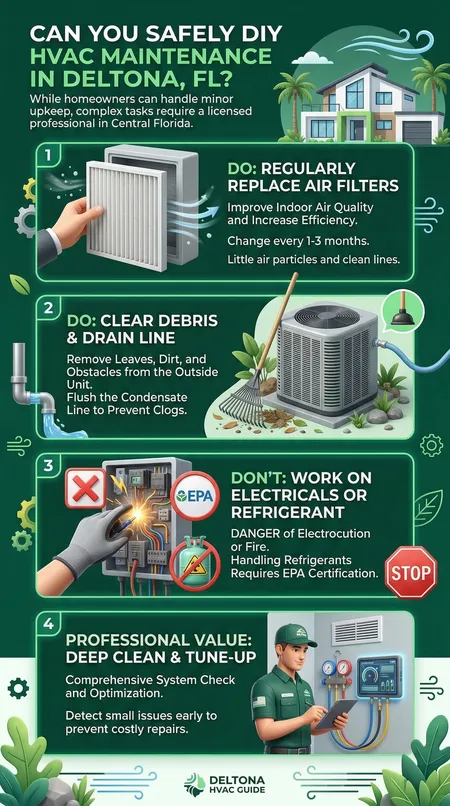
Filter changes (every 30–60 days in Deltona due to high pollen and dust) are a homeowner's responsibility.
Clearing the condensate drain line is a manageable DIY task — and critical in Florida's humidity.
Cleaning around the outdoor unit and keeping vegetation back 2 feet is homeowner territory.
Professional annual tune-ups remain necessary. DIY cannot replicate refrigerant checks, coil cleaning, or electrical inspections.
Bottom line: DIY + one professional tune-up per year is the right combination for Deltona homes.
Top Takeaways
DIY filter changes are non-negotiable in Deltona — do them every 30–60 days, not the national average of 90.
Condensate drain maintenance is the most underrated homeowner task in humid Florida climates.
Annual professional tune-ups aren't optional here — Deltona's climate makes them a necessity, not a luxury.
Outdoor unit clearance and cleanliness directly affect efficiency and should be a monthly habit.
DIY alone is not enough. Pairing homeowner upkeep with professional inspections is the only complete maintenance strategy for Central Florida systems.
What Deltona Homeowners Can Handle Themselves
Changing Air Filters Regularly
This is the single most impactful thing you can do as a homeowner. In Deltona, filters clog faster than the national average due to year-round pollen, construction dust in developing neighborhoods, and high humidity that causes particles to stick together.
Replace filters every 30 days if you have pets or allergies.
Use at minimum a MERV 8 filter for adequate particle capture.
Check the filter monthly, even if you're on a 60-day schedule — Deltona's seasonal pollen surges can clog a filter ahead of schedule.
Clearing the Condensate Drain Line
Florida homes produce substantial condensation. A clogged drain line causes water backup, mold growth, and can trigger safety shutoffs that leave you without cooling.
Pour a cup of distilled white vinegar down the drain line every 1–3 months.
Check the float switch near the air handler to confirm it's functioning.
If you notice water pooling near your air handler, the drain is likely backed up and needs attention immediately.
Keeping the Outdoor Unit Clear
Your condenser unit needs unobstructed airflow to release heat efficiently.
Maintain at least 2 feet of clearance around the unit.
Rinse the exterior fins with a garden hose (gentle pressure, top-down) to remove pollen and debris.
Avoid letting lawn clippings, mulch, or overgrown shrubs crowd the unit — a common issue in Deltona's landscaped subdivisions.
Checking and Adjusting Thermostat Settings
Programmable and smart thermostat optimization is a meaningful efficiency task homeowners can manage. In Deltona, where systems run almost continuously, even a 1–2 degree adjustment during unoccupied hours can meaningfully reduce wear and energy costs.
What Requires a Professional in Deltona
Some tasks aren't about skill level — they're about equipment, safety, and the fact that Deltona's climate punishes overlooked details.
Refrigerant inspection and recharge require EPA certification. Low refrigerant causes the compressor to overwork, and it's one of the most common causes of premature system failure in Florida's heat.
Evaporator and condenser coil cleaning requires chemical cleaners, proper PPE, and the knowledge to avoid damaging delicate fins. Dirty coils are one of the biggest efficiency killers in humid climates.
Electrical component checks — including capacitors, contactors, and wiring — deteriorate faster in Florida's heat and humidity. These inspections should happen annually at a minimum.
Duct inspections matter in Deltona because attic temperatures regularly exceed 130°F in summer. Duct connections that loosen over time cause significant energy loss and comfort problems that aren't visible without proper equipment.
"In Central Florida, a system running year-round degrades differently than one in a seasonal climate — we consistently find that homeowners who do the basics between professional visits see dramatically better equipment longevity and fewer emergency calls during peak summer demand."
Essential Resources
1. EPA Guide to Indoor Air Quality and HVAC Systems
The EPA provides comprehensive guidance on how HVAC maintenance affects indoor air quality, including filter selection, ventilation, and humidity control relevant to Florida homes.
https://www.epa.gov/indoor-air-quality-iaq
2. U.S. Department of Energy — Home Cooling Tips
The DOE offers practical, evidence-based cooling efficiency guidance including maintenance tasks that directly reduce energy costs for homes in hot climates.
https://www.energy.gov/energysaver/home-cooling-systems
3. ASHRAE — Standards for HVAC System Maintenance
ASHRAE sets the technical standards that govern proper HVAC maintenance practices, including ventilation rates and equipment inspection protocols.
https://www.ashrae.org/technical-resources
4. Florida Department of Health — Indoor Air Quality Resources
Florida-specific guidance on maintaining healthy indoor environments, with information relevant to the state's high-humidity conditions.
https://www.floridahealth.gov/environmental-health/indoor-air-quality/index.html
5. Florida Division of Vocational Rehabilitation / MyFloridaLicense.com — Verify Contractor Licenses
Before hiring any HVAC professional in Deltona, verify their Florida state license to ensure compliance with local regulations.
https://www.myfloridalicense.com/wl11.asp
6. Air Conditioning Contractors of America (ACCA) — HVAC Quality Standards
ACCA provides standards and consumer resources for understanding what a quality HVAC maintenance visit should include.
https://www.acca.org/consumers
7. ENERGY STAR — HVAC Maintenance Checklist for Homeowners
ENERGY STAR's checklist helps homeowners understand which tasks they own and which require professional attention to maintain system efficiency.
https://www.energystar.gov/campaign/heating_cooling
Supporting Statistics
1. The Department of Energy reports that HVAC systems account for nearly 50% of home energy use.
https://www.energy.gov/energysaver/home-cooling-systems
In Deltona, where systems run year-round without meaningful off-seasons, that figure likely skews even higher, making maintenance not just a comfort issue but a significant financial burden.
2. The EPA estimates that indoor air can be 2–5 times more polluted than outdoor air.
https://www.epa.gov/report-environment/indoor-air-quality
In Central Florida, where homes are sealed tightly against heat and humidity, this gap is often wider — a well-maintained HVAC system and consistent filter changes are the primary line of defense.
3. ENERGY STAR data shows that a properly maintained HVAC system can reduce energy consumption by up to 15%.
https://www.energystar.gov/campaign/heating_cooling
For a Deltona home running its system effectively 12 months a year, that 15% compounds into meaningful savings — and extends equipment life by reducing thermal stress on core components.
Final Thought & Opinion
HVAC maintenance in Deltona isn't the same conversation as it is in most parts of the country. Your system isn't seasonal equipment — it's infrastructure that runs continuously under real thermal stress.
The homeowners who get the most out of their systems in this area share one common habit: they treat DIY maintenance and professional service as partners, not substitutes. Changing filters, clearing drain lines, and keeping the outdoor unit clean between visits are genuinely impactful. But no amount of DIY replaces refrigerant checks, coil cleaning, and electrical inspections by someone who's seen what Central Florida summers actually do to HVAC equipment over time.
If your system is more than 8–10 years old and you haven't had a professional tune-up in the past year, that's the most important next step — regardless of how diligent your DIY habits have been.
FAQ on "HVAC Maintenance in Deltona"
Q1: How often should I change my air filter in Deltona?
A: Every 30–60 days. Key factors that shorten that window:
Pets in the home
Allergy sufferers
Spring oak pollen season
Active construction in your neighborhood
Q2: Can I clean my own HVAC coils?
A: Outer condenser coils can be rinsed gently with a garden hose. Evaporator coils (inside the air handler) should be professionally cleaned. Using the wrong chemicals or technique damages delicate fins and voids warranties.
Q3: What's the most important DIY HVAC task for Deltona homeowners?
A: Condensate drain maintenance. In Florida humidity, a clogged drain line causes:
Water damage to your air handler
Mold growth in the drain pan
System shutoff from a tripped float switch Pour white vinegar down the drain line every 1–3 months.
Q4: How many times per year does an HVAC system in Deltona need professional service?
A: At a minimum, once per year. Best practice is:
One tune-up before peak summer demand (March–April)
A second inspection in fall to address wear from the summer season
Q5: Will skipping professional maintenance void my HVAC warranty?
A: Potentially, yes. Most manufacturer warranties require documented proof of regular professional maintenance. DIY-only upkeep typically does not satisfy warranty maintenance requirements. Always check your system's specific warranty terms and keep service records.
Schedule Your Annual HVAC Tune-Up
An annual professional inspection is the most cost-effective thing you can do for a system working this hard in Central Florida's climate. Don't wait for a breakdown in July to find out what a spring tune-up would have caught.
Here is the nearest branch location serving the Deltona area. . .
Filterbuy HVAC Solutions
2900 Titan Row # 128, Orlando, FL 32809
(407) 204-1859
https://maps.app.goo.gl/1VWkzrEiCyb4sKPT7b
Here are driving directions to the nearest branch location serving Deltona. . .